
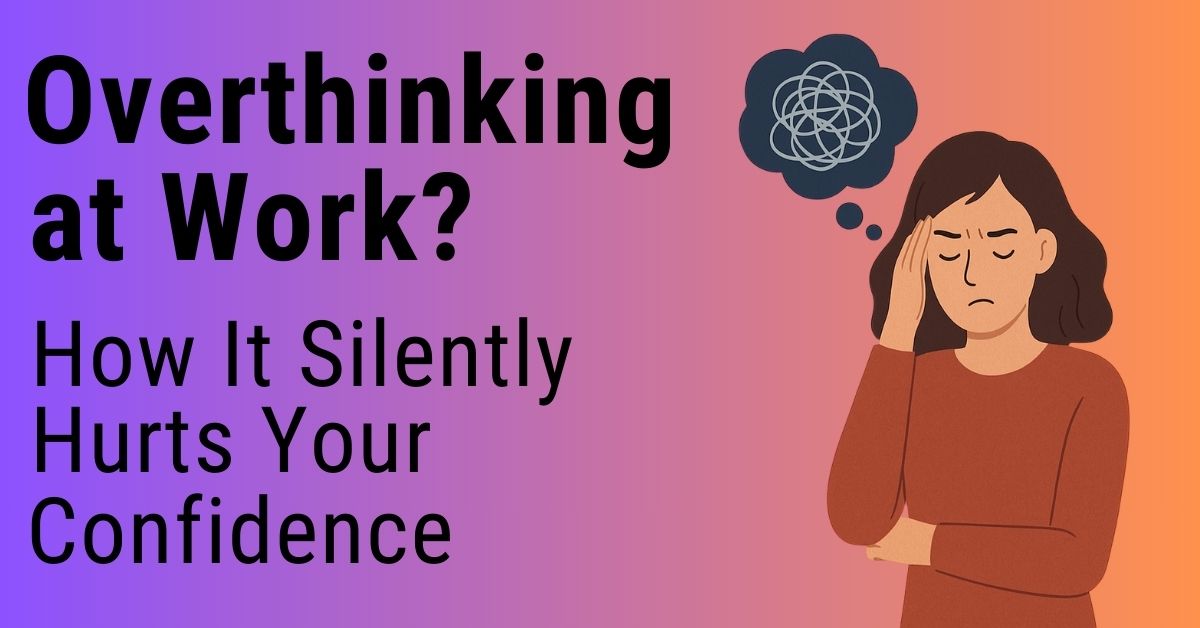
Overthinking at work may seem like a harmless habit at first glance because you’re just trying to be responsible, careful, and professional. You double-check things, replay conversations, and try to make sure nothing goes wrong. It may seem like you’re simply doing your job diligently. But gradually, without you even noticing, that harmless habit begins to turn into mental noise.
It starts with small thoughts, like, “Was that okay?” or “What if I sounded silly?” Then it turns into over-analyzing every email, every word you say, or every decision you make. Instead of working with confidence, you start doubting yourself. And that’s when overthinking stops being helpful.
The real cost of overthinking in the workplace isn’t just time; it’s mental peace, clarity, and ultimately, your self-confidence. The more you doubt your decisions, the more your mind begins to believe that you can’t be trusted. This gradually fades your self-confidence.
In this blog, we will explore how overthinking at work silently damages your self-confidence, how to recognize it, and how to slowly rebuild your confidence – one step at a time. Because you deserve to feel calm, capable, and confident in what you do.
What Overthinking at Work Really Looks Like
If someone asked you, “Do you overthink at work?” you might smile and say, “I’m just being careful,” or “I like to do things properly.” And honestly, that’s a completely valid response. Many of us don’t even realize that overthinking at work can quietly become emotionally draining.

It often shows up in simple, everyday moments like these:
- You read the email over and over before sending it, just to make sure it “sounds right.”
- You replay the conversation in your mind late into the night, wondering if you said something weird.
- You delay starting a task not because it is difficult, but because you are not enough prepared for it.
- You seek feedback from others, not for clarity, but because you don’t fully trust your own judgment.
- Even small decisions like choosing a template or replying to a message feel heavier than they should.
If any of this sounds familiar to you, you’re not alone.
Overthinking in the workplace is often hidden behind words like professionalism, perfectionism, or caution. But when it starts affecting your peace, confidence, or productivity, it’s no longer about being careful. It’s your mind trying to protect you… because deep down it’s scared.
The Silent Connection between Overthinking and Confidence
Think of confidence as a muscle. It doesn’t grow by just thinking; it grows by doing, by trying, by believing in yourself, even when you’re not 100% sure.
Now imagine that overthinking at work quietly prevents you from using that muscle. It doesn’t yell or push; it simply whispers, “Are you sure?” “What if you’re wrong?” And gradually, instead of trusting your own judgment, you start looking to someone else to confirm it. Over time, your mind starts to believe, “Maybe I can’t trust myself. Maybe I need someone else to tell me I’m right.”
That’s how confidence doesn’t disappear overnight; it fades gradually. Not because you are not capable, but because you have stopped believing that you are capable.
How Overthinking Damages Your Confidence (Silently and Slowly)
You start doubting your abilities -The more you hesitate or seek reassurance, the more your mind learns to question itself.
You begin to fear decisions -Even simple choices feel risky, as if there’s always a “right” answer that you might miss.
You start depending on others too much -Instead of trusting your own judgment, you wait for approval, even if you already know the answer.
You lose your voice -You stay quiet in meetings, fearing that your ideas aren’t good enough, when in fact, they might be just what’s needed.
You play small -You avoid opportunities because you wait to feel completely confident, without realizing that confidence often comes after taking action, not before.
Overthinking at work not only stalls your progress; it also slowly convinces you that you’re not ready, not capable, and not enough. When in reality, you always were.
Why We Overthink at Work: The Emotional Roots (It’s Not Just About Work)
Most of us assume that overthinking at work just means being alert, responsible, or trying to avoid mistakes. But beneath the surface, it often has much deeper emotional roots that we rarely talk about.
1. Fear of judgment
You’re not just worried about getting something wrong; you’re worried about how it might make you look. “What if they think I’m not smart enough? What if they think I can’t handle it?”
2. Fear of failure
Even small tasks can feel big when your mind believes one mistake could define your capability or even your worth.
3. Need for approval
You might already know the answer, but you wait for someone else to confirm it. Not because you lack clarity, but because you want reassurance.
4. Past experience
Maybe you’ve made a mistake before, and it still lingers in your memory. Now your mind tries to ‘protect’ you by replaying every possible outcome.
5. Pressure to prove yourself
Whether it’s a new role, a new manager, or trying to advance in your career, it’s natural to want to do everything right. But sometimes this pressure turns into silent anxiety.
At its core, overthinking at work isn’t just a thinking problem; it’s an emotional response. It’s your mind trying to keep you safe, but sometimes keeping you stuck.
The Mindset Shift: From “What If I’m Wrong?” to “I Can Handle It Even If I’m Wrong”
Here’s a gentle truth: The real issue isn’t that you might make a mistake – It is believing that one mistake says something about your ability, your intelligence, or your value.
Confidence doesn’t mean always being right. It means believing in yourself, even when you’re unsure. It’s a quiet confidence that no matter what happens, you’ll figure it out.
So instead of letting your mind spiral into:
What if I make the wrong choice?”
Try gradually shifting to this:
“Even if I make a mistake, I can handle it. I can learn from it.”
That’s the mindset that helps you overcome overthinking at work. Not by forcing certainty, but by learning to be comfortable with a little uncertainty because you trust yourself to handle whatever comes next.
How Overthinking at Work Silently Affects Productivity, Growth, and Emotional Well-Being
1. It steals your time
Even simple tasks seem complicated. You spend more time thinking than doing. Planning takes the place of action, and your to-do list grows while your progress doesn’t. Overthinking like this often increases your mental load.
2. It creates emotional exhaustion
Even on days when you haven’t done much work, you feel mentally tired. This is because thinking too much feels like hard work, even if all the work is happening in your head.
3. It hurts your ability to learn
When you’re afraid of making mistakes, you try to avoid them at all costs. But the truth is, growth doesn’t come from perfect thinking. It comes from trying, experiencing some failure, learning, and trying again.
4. You stop taking opportunities
That new project, the leadership role, the promotion – you tell yourself you’re “not ready” yet. But deeper down, it’s not a lack of skills; it’s a hesitation fueled by overthinking at work.
And the most painful part? The regret that follows. When overthinking at work keeps you stuck, the work gradually begins to feel overwhelming, small, and less satisfying, not because you lack the ability, but because you have stopped believing in it.
Practical Ways to Reduce Overthinking at Work (Gently and Gradually)
You don’t have to fight your thoughts or silence them. You just have to interrupt them gently, so your brain learns that it’s safe to proceed without knowing every possible outcome. Here are some kind and practical ways to get started:
1. The 70% rule
You don’t need to be 100% confident to take action. Even if you’re 70% confident, that’s usually enough to move forward. Clarity often comes after the start, not before.
2. Give decisions a time limit
Instead of thinking endlessly, set a simple timer – ten minutes for small decisions (emails, replies), and thirty minutes for moderate ones. Make a decision and move forward. Trust that whatever happens next, you can handle it.
3. Practice “good enough”
Instead of asking, “Is this perfect?” try asking, “Is this clear, useful, and understandable?” Most of the time, that’s enough.
4. Action over analysis
When you feel yourself getting stuck in mental loops, take one small step. Send the draft. Make the call. Start the task. Action gradually breaks the cycle of overthinking.
5. Build a self-trust journal
At the end of each day, write down a decision you handled well. This slowly but surely teaches your brain – “I can trust myself.”
6. Limit the “mental replays”
Before overanalyzing something you said or did, ask: “Will this matter in a month?” If not, allow yourself to let it go.
7. Speak to yourself as you would to a friend
You would never tell your friend that they’re not capable or ready. So why tell yourself that? You deserve the same kindness you extend to others.
Emotional Healing: Rebuilding Confidence after Overthinking at Work
Confidence doesn’t magically appear overnight; it grows gradually when we start doing three simple things:
1. Accept imperfection
You don’t have to be perfect to earn trust. People trust those who demonstrate courage, honesty, and hard work, not those who never make mistakes.
2. Celebrate small wins
You don’t have to wait for a big promotion or a flawless presentation. Every time you speak up, make a decision, or even try something when you’re unsure, you’re building your confidence.
3. Stop apologizing for existing
Your thoughts, your ideas, and your presence – they all matter. You don’t have to present them perfectly to command a place in the room.
As you gradually replace overthinking with small moments of self-belief, you begin to feel something beautiful: you become emotionally stronger as you move forward, one step at a time.
Final Thought: Trust Yourself a Little More Today
If you’re stuck in a cycle of overthinking at work, I want you to keep this in mind –
You don’t need to be completely confident to take a step. You don’t need to have every answer before you speak. You don’t need to be perfect to be valued or respected.
You need a little more self-confidence, just enough to make a decision, take a step, or share an idea.
Confidence doesn’t develop completely in an instant. It grows quietly… every time you choose courage over doubt.
So today, don’t try to silence every doubt. Just trust yourself a little more than yesterday.