
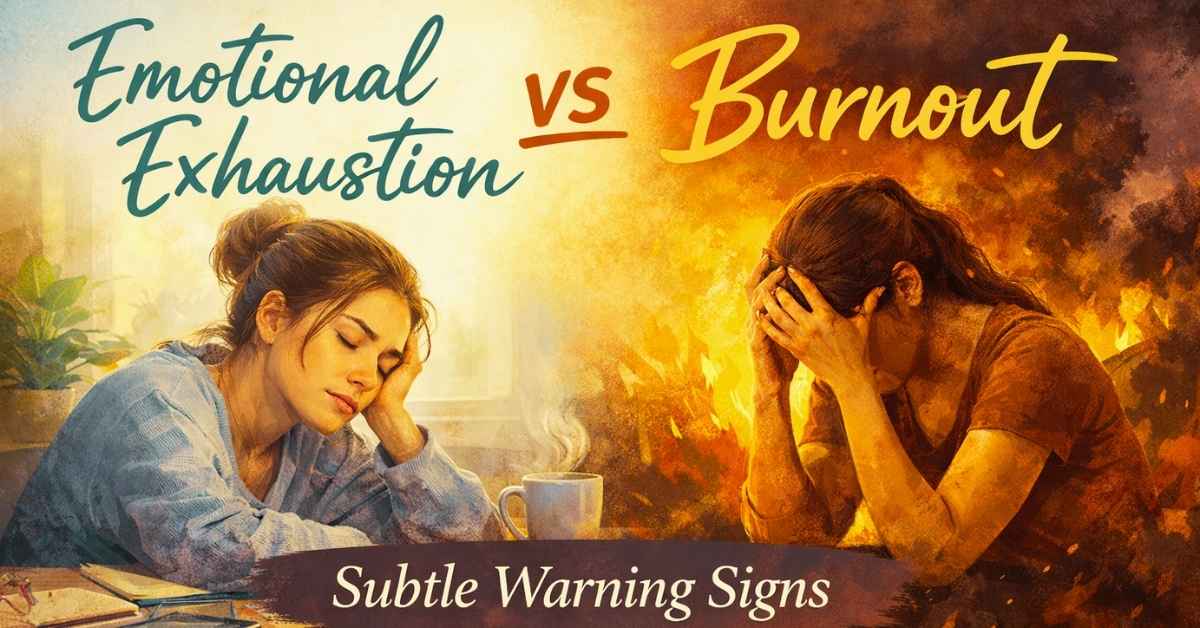
Have you ever felt tired when you opened your eyes in the morning, not in your body, but somewhere deeper? The kind of fatigue that persists even after a full night’s sleep, that even your favorite coffee can’t fix, and that even a long weekend can barely touch. If you’ve felt this silent heaviness, you’re not alone. Many professionals carry this burden without understanding what it means or where it’s coming from.
This is why it’s so important to talk about emotional exhaustion vs burnout. From the outside, they may seem similar – low energy, low patience, and low motivation. But on the inside, they feel very different. Emotional exhaustion is like a quiet nudge, a gentle warning that something inside you is running low. Burnout occurs when this warning goes unheeded for too long.
In this blog, we will gently explain emotional exhaustion vs burnout in a warm, caring, and relatable way – so you can recognize subtle signs early, listen to what your mind and body are trying to tell you, and start healing before everything feels too overwhelming.
Take a breath. You’re safe here. Let’s explore this together.
Emotional Exhaustion vs Burnout: What’s the Real Difference?
You’ve likely heard the word “burnout” everywhere: on LinkedIn posts, in workplace discussions, and in health conversations. But “emotional exhaustion” doesn’t get as much attention, even though it’s often the first stage before burnout occurs.
To understand the difference between emotional exhaustion and burnout, imagine it like this:
- Emotional exhaustion occurs when your emotional capacity begins to decrease. You feel tired, overwhelmed by even small tasks, and emotionally drained.
- Burnout occurs when emotional, physical, and mental exhaustion combine to impact your motivation, performance, and sense of identity.
Both are real. Both are valid. And both deserve your attention.
What Is Emotional Exhaustion?
Emotional exhaustion occurs when your emotional “battery” runs out. You’re not just tired; you feel emotionally unavailable, easily overwhelmed, and disconnected from your usual enthusiasm.

Some people describe emotional exhaustion as:
- “I feel empty.”
- “I don’t have the energy to care anymore.”
- “Everything feels heavier than it should.”
When exploring emotional exhaustion and burnout, emotional exhaustion is the initial stage. It’s your internal mechanism demanding rest, boundaries, and support.
Common Causes of Emotional Exhaustion
- Consistent decision-making
- Taking emotional responsibility for others
- Workplace stress or pressure
- High cognitive load
- Toxic environments
- Being “on” all the time
- Chronic overthinking
- Never having true downtime
It’s important to recognize it early, because emotional exhaustion is a warning sign that becomes more intense the longer it’s ignored.
What Is Burnout?
Burnout is the result of prolonged, uncontrolled stress. It is a combination of emotional exhaustion, mental fatigue, and physical depletion.
The World Health Organization describes burnout as an “occupational phenomenon,” meaning it’s very much connected to work – but the truth is that emotional labor and life stress can also push you towards burnout.
When comparing emotional exhaustion and burnout, burnout is a stage where:
- Your motivation decreases
- Your productivity decreases
- You feel pessimistic
- You begin to feel isolated
- You lose your sense of accomplishment
Burnout not only affects your mood and energy, but also your self-esteem. It changes your behavior at work, at home, and even in your inner world.
Why the Distinction Matters?
Understanding emotional exhaustion vs burnout isn’t just about labeling your experience; it’s about early intervention.
Emotional exhaustion can be overcome with rest, boundaries, and self-awareness.
Burnout requires deep recovery, a change in habits, and sometimes even a lifestyle change.
Knowing where you currently stand helps you choose what kind of support, improvement, or action you need.
Subtle Warning Signs You Shouldn’t Ignore
Below are some subtle signs that often appear long before burnout fully sets in. Think of these as subtle signals from your mind and body.
To ensure clarity, we will explore these signs through the lens of emotional exhaustion vs burnout.
1. Your emotions feel dulled or “muted”
In emotional exhaustion, you may feel your emotions fading away. Not completely gone, but quieter. It’s like someone turned down the emotional volume inside you.
You might notice:
- Decreased enthusiasm for things you usually enjoy
- Lack of patience
- Feeling numb or indifferent
Compared to emotional exhaustion and burnout, this muted feeling aligns more with emotional exhaustion: a beginning, not an endpoint.
2. You are operating on autopilot
Do you ever finish a task without remembering it?
Does the entire day seem to go by in a blur?
When emotional exhaustion sets in, your brain goes into autopilot mode to conserve energy. This is a coping mechanism.
However, if autopilot becomes your baseline for weeks or months, burnout may be developing.
This pattern often appears in discussions on emotional exhaustion and burnout because it is one of the earliest indicators that your cognitive load is too high.
3. You become more overwhelmed by small tasks
If responding to a simple email feels like climbing a mountain or a small change in your routine completely throws you off guard, it could be emotional exhaustion.
But if you actively avoid tasks, procrastinate everything, or become exhausted by even basic tasks, that’s where burnout comes in.
The spectrum of emotional exhaustion vs burnout shows that emotional exhaustion causes immediate emotional overload, while burnout affects your ability to function.
4. You feel emotionally fragile
Everyone has vulnerable moments in life, but emotional exhaustion makes these moments occur more frequently.
You might:
- Cry more easily
- Feel irritated by minor inconveniences
- Get hurt by neutral comments
When comparing emotional exhaustion and burnout, fragility reflects emotional exhaustion, but emotional detachment is a sign of burnout.
5. You feel like you have nothing left to give
This feeling is powerful and painful.
Emotional exhaustion feels like you’re under a lot of stress. Burnout feels like you’re completely drained.
When assessing emotional exhaustion and burnout, ask yourself:
“Do I feel exhausted, or do I feel defeated?”
Your answer reveals where you fall on this spectrum.
6. You are constantly tired, even after resting
If you sleep but don’t feel refreshed, your exhaustion may not be physical, but emotional.
With emotional exhaustion:
- Sleep helps, but not fully.
With burnout:
- Sleep doesn’t make much difference.
This distinction is often highlighted in discussions about emotional exhaustion vs burnout, as sleep quality is deeply linked to emotional well-being.
7. Your inner critic gets louder
Stress takes a toll on your self-esteem. Emotional exhaustion can amplify negative thoughts like:
- “I’m not doing enough.”
- “I don’t know if I can handle this.”
- “Why can’t I keep up as others do?”
When burnout occurs, these thoughts often turn into deep self-doubt.
Your internal dialogue is a key indicator in the journey to emotional exhaustion to burnout.
8. You withdraw emotionally or socially
Emotional exhaustion makes you crave peace.
Burnout disconnects you from people, conversations, responsibilities, and sometimes even yourself.
The shift from withdrawal to emotional detachment is a core differentiator in emotional exhaustion and burnout.
What Happens to Your Body: Physical Signs
Because your emotional and physical systems are deeply connected, your body also reveals where you are on the emotional exhaustion vs burnout spectrum.
Common physical signs include:
- Headaches
- Digestive issues
- Anxiety symptoms
- Tightness in the chest
- Muscle tension
- Changes in appetite
- Light sensitivity or noise sensitivity
Your body speaks louder when your emotions are on overload.
What Happens to Your Mind: Cognitive Signs
- Brain fog
- Forgetfulness
- Difficulty making decisions
- Slower thinking
- Overthinking
- Irrational worry
These cognitive indicators help you differentiate emotional exhaustion and burnout, because they intensify the deeper you go into burnout.
Why High Achievers Are More at Risk
You might be wondering why this sounds so familiar and why people who care deeply often struggle more.
Here’s the truth: Those who are responsible, empathetic, high-performing, and self-motivated often struggle with emotional exhaustion until they reach a state of burnout.
You give, and give, and give, until something inside you gently breaks.
Understanding emotional exhaustion vs burnout becomes even more important for you because early signs get masked by your ability to “keep going.”
How to Recover From Emotional Exhaustion
If you identify more with emotional exhaustion than burnout, this is your chance to intervene early.
Try these steps:
- Create emotional boundaries -Say no, back off, pause – without guilt.
- Schedule recovery periods -Planned rest is still rest.
- Reduce emotional labor -You are not responsible for everyone’s feelings.
- Talk to someone you trust -Sharing reduces emotional load.
- Rebuild your energy with micro-joys -Tiny pleasure moments help restore your emotional core.
The goal is to prevent emotional exhaustion from turning into burnout. This is the crux of the emotional exhaustion vs burnout discussion.
How to Recover From Burnout
Because burnout is deeper and more systemic, it requires bigger changes.
Steps to begin healing:
- Reevaluate your workload or responsibilities -Something structurally needs to change.
- Seek professional support -Therapy or coaching can guide recovery.
- Rebuild your identity slowly -Burnout often damages your self-esteem.
- Prioritize deep rest—not passive rest -Deep rest includes emotional, creative, sensory, and mental restoration.
- Reintroduce joy and meaning gradually -Burnout dims everything; small sparks can reignite motivation.
Understanding emotional exhaustion vs burnout helps you choose which healing path best suits your current emotional state.
A Helpful Checklist: Emotional Exhaustion vs Burnout
Use this quick guide to understand where you stand:
| Experience | Emotional Exhaustion | Burnout |
|---|---|---|
| Emotional Capacity | Low, but present | Nearly empty |
| Motivation | Mild drop | Severe decline |
| Work Performance | Inconsistent | Significantly reduced |
| Emotional State | Overwhelmed | Detached or cynical |
| Recovery | Possible with moderate rest | Requires deeper intervention |
| Physical Symptoms | Mild to moderate | Chronic and persistent |
| Mental Clarity | Occasional fog | Prolonged cognitive fatigue |
This checklist emphasizes why understanding emotional exhaustion vs burnout is so important; it gives you a map.
Final Thoughts
The line between emotional exhaustion vs burnout is thin, but incredibly meaningful.
Emotional exhaustion is the initial whisper.
Burnout is the breaking point.
Most people don’t realize they’ve moved from one to the other until they’re deep into the struggle. But you don’t have to wait that long. Your exhaustion is valid. Your emotions are real. And your need for comfort isn’t a sign of weakness; it’s a sign of awareness.
Whether you’re emotionally stressed or completely exhausted, you deserve care, compassion, and genuine support. Healing is possible, and it starts with recognizing what your mind and body are trying to tell you.
You’re not behind. You’re not failing.
You’re human, and you’re allowed to pause.