
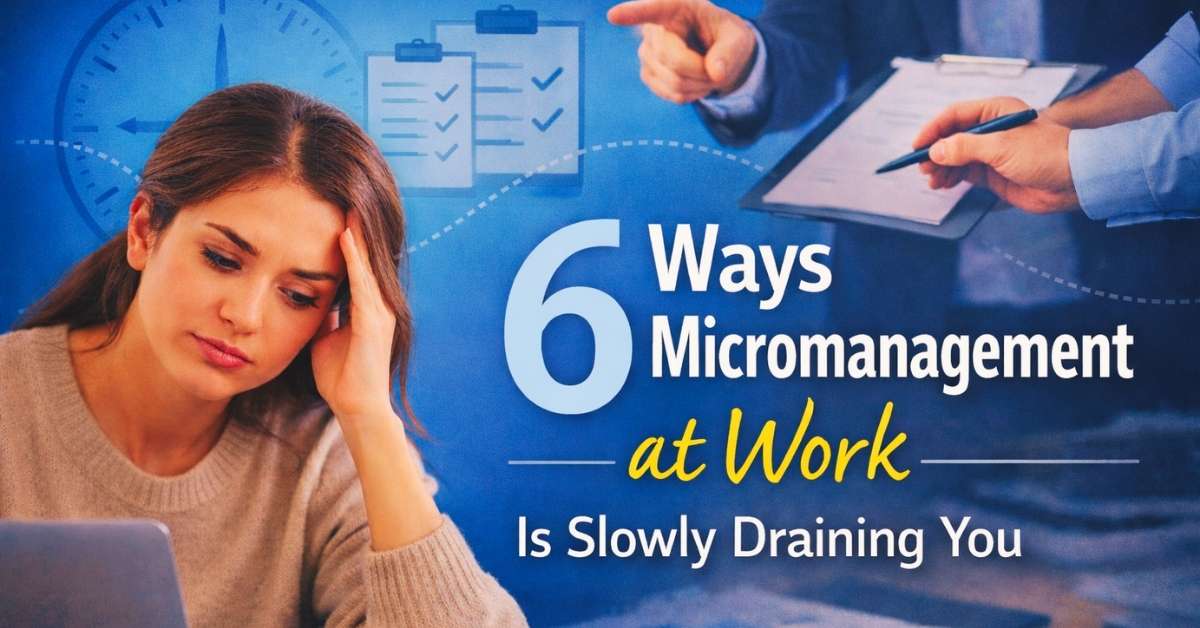
At first, micromanagement at work doesn’t always feel like a problem. It may seem like the manager is too involved or wants to be too careful about details. You might even tell yourself, ‘It’s okay, once I prove myself, this will all stop.’ So you adapt. You work harder. You don’t make a fuss.
But over time, something changes.
You feel a strange nervous feeling in your stomach before the meeting. You start doubting even those things that you used to do with confidence earlier. Tasks that seemed easy before now seem strangely exhausting. This is not because you have changed, but because you are being constantly monitored, corrected, or guided a little more closely.
Micromanagement in the workplace rarely comes across as a big, obvious issue. Instead, it slowly wears you down through repeated contact, subtle control, and the silent feeling that you’re not fully trusted. And because this type of behavior is so common in the workplace, many people tend to blame themselves rather than question the environment.
If you’ve been feeling emotionally tired, disengaged, or not quite like yourself at work, micromanagement at work may be playing a bigger role than you realize. Let’s talk about six ways it quietly impacts your mental well-being, and why recognizing it is the first step toward protecting your energy.
1. It Gradually Erodes Your Confidence
One of the hardest things about micromanagement at work is how it quietly affects your self-confidence. You might not even notice it at first: a small mistake here, a suggestion there. But when every task is reviewed, changed, or redone, even if you did it well, you start to wonder if you’re actually doing a good job.

As time goes on, you find yourself hesitating. You pause before making decisions that you used to make easily. You double-check the things you already know how to do. You wait for approval not because you need it, but because it makes you feel more secure. This isn’t a reflection of your ability; it’s what happens when micromanagement in the workplace slowly teaches you to doubt your own judgment.
The most exhausting thing about all of this is that no one ever says, “I don’t trust you.” Instead, the message is delivered quietly through constant monitoring and control. Day by day, that unspoken doubt creeps into the mind.
Confidence grows when there is trust and autonomy. When micromanagement in the workplace takes those away, self-doubt naturally fills the space, even for competent and experienced professionals.
2. Your Mental Load Becomes Heavier Than Your Actual Work
Micromanagement at work not only increases your workload, but it also silently fills your mind. You’re no longer focused only on doing your job properly; you’re also spending energy trying to predict reactions, preferences, and possible criticism before it even happens.
You may find yourself asking:
- Will this be approved?
- Should I phrase this differently?
- What if this isn’t exactly how they want it done?
This kind of constant mental scanning is exhausting. Even simple tasks can seem daunting because your mind is always “on,” trying to avoid mistakes rather than getting things done. Over time, micromanagement in the workplace can lead to a feeling of hyper-vigilance, leaving you feeling mentally exhausted before your day has even fully begun.
This type of cognitive stress often goes unnoticed because it doesn’t show up as obvious stress. However, this is one of the subtle ways that micromanagement in the workplace can lead to emotional exhaustion.
3. You Start Losing Your Sense of Ownership and Motivation
A healthy work environment allows you to feel a sense of ownership towards your work. You make decisions, present ideas, and feel proud of the results. But micromanagement at work gradually takes away that feeling.
When every small decision is dictated or closely monitored, your role begins to change. Instead of being an active contributor, you start to feel like you’re just following instructions. You may stop thinking creatively or making suggestions, not because you don’t care, but because experience has taught you that your suggestions aren’t really welcome.
Over time, this affects motivation. You get the necessary work done, but the enthusiasm disappears. You are less emotionally connected, less curious, and less active than before. Micromanagement in the workplace quietly turns meaningful work into something mechanical.
Losing this sense of ownership can be extremely exhausting. When your efforts and initiatives are not valued, it becomes difficult to stay motivated. And without realizing it, micromanagement in the workplace can disconnect you from the very parts of yourself that once made work feel fulfilling.
4. It Blurs the Line between Accountability and Control
There’s a crucial difference between receiving support and being controlled, but micromanagement at work often blurs that line. What’s presented as “accountability” can start to feel more like constant supervision.
Instead of being trusted to handle your work independently, you may have to explain every little decision or step along the way. Even when you get good results, the focus remains on how you did the work, not on what you achieved. Over time, this creates stress and anxiety.
You might start feeling anxious during meetings or overly cautious in your communication. Even simple updates can feel stressful because you don’t know how closely they will be examined. Micromanagement in the workplace keeps you focused on avoiding mistakes rather than learning, growing, or doing your best.
This lack of freedom can feel mentally suffocating. When trust is replaced by control, the focus becomes more on compliance rather than contribution to work. And that constant pressure is one of those indirect ways of micromanagement in the workplace that leaves you emotionally exhausted.
5. Your Work Stress Follows You Home
One of the quieter effects of micromanagement at work is how difficult it becomes to completely mentally detach from work. Even after the work day is over, your mind is often stuck in work mode.
You may find yourself replaying conversations over and over, overthinking feedback, or worrying about whether what you submitted was “good enough.” Even during your private time, there’s a lingering tension, as if you’re still being watched or evaluated. Micromanagement in the workplace doesn’t always end at the office door.
Because you’re constantly managing expectations and avoiding mistakes throughout the day, your nervous system rarely gets a chance to fully relax. Over time, this makes it difficult to relax, enjoy time off, or be fully present with loved ones.
What makes this process even more tedious is that it doesn’t always look dramatic. You may still be working and getting things done, but deep inside you feel a fatigue that even rest can’t cure. This is a subtle way in which micromanagement in the workplace can slowly seep into your personal life and affect your overall well-being.
6. It Can Lead to Burnout without You Realizing It
Burnout isn’t just caused by long hours or a heavy workload. Often, this grows when you feel constantly under surveillance, feel restricted, or are unable to work in a way that feels natural to you, and micromanagement at work creates exactly that kind of environment.
Because its effects are gradual, many people initially don’t understand what’s happening. You may also start to feel emotionally dull, listless, or unusually tired even after a vacation. Tasks that used to seem easy now seem burdensome, and motivation becomes difficult. Micromanagement in the workplace quietly drains your energy before you even label it as burnout.
What makes this matter even more complicated is that everything may seem “fine” from the outside. You’re still meeting expectations, still present, still performing well. But deep inside, you feel exhausted. Over time, this constant feeling of pressure and lack of control can push your mind and body into burnout mode.
Understanding how micromanagement in the workplace contributes to burnout isn’t about being dramatic; it’s about understanding why you feel this way and allowing yourself to take it seriously.
Why Micromanagement at Work Hurts More Than We Admit
Many professionals underestimate the impact of micromanagement at work because it doesn’t appear to be obviously harmful. There is no shouting, no public criticism, and no overt confrontation. In fact, it is often wrapped in terms like “support,” “guidance,” or “thorough investigation,” making it even more difficult to question.
But emotional strain doesn’t need to be loud to be real. It can come from being constantly controlled, second-guessed, or quietly monitored. Over time, micromanagement in the workplace sends a subtle but powerful message: you are not fully trusted to handle things on your own. And hearing that message day in and day out hurts the mind, even if no one ever says it out loud.
Admitting this doesn’t mean you’re blaming your manager or thinking negatively about your workplace. It simply helps shift the focus from “What’s wrong with me?” to “What am I reacting to?” And that shift from self-blame to self-awareness is an important step toward protecting your mental health.
What You Can Do If You’re Experiencing Micromanagement at Work
While you may not be able to change your manager or workplace overnight, there are ways you can protect your mental health and regain a sense of stability:
Name the experience: Recognizing micromanagement at work for what it is can be grounding. This reduces feelings of self-doubt and reminds you that there’s a valid reason for what you’re feeling.
Clarify expectations: When possible, ask for clear outcomes and priorities rather than constantly interrupting every step of the way. Knowing what success looks like can reduce unnecessary upheaval.
Set micro-boundaries: Even small changes can make a difference. Instead of constantly monitoring, suggest scheduling regular conversations so you can work more comfortably without the fear of being constantly monitored.
Document your work: Keeping a record of what you’ve done and how you’ve carried out tasks can gradually build confidence and reduce repeated questions or probing.
Reflect on long-term fit: Sometimes, micromanagement at work isn’t related to individual performance at all; it’s a sign of a deeper cultural imbalance that needs to be addressed.
Most importantly, remind yourself that wanting autonomy, trust, and freedom to act at work doesn’t make you difficult or demanding; it simply makes you human.
Final Thoughts
If micromanagement at work is slowly wearing you out, your exhaustion is natural. You’re not “too sensitive” or difficult; you’re reacting to an environment that limits trust, autonomy, and emotional safety, all essential to doing meaningful work and staying mentally healthy.
Acknowledging the impact of micromanagement at work doesn’t mean blaming anyone or portraying the workplace as the villain. This means listening to your own experience and recognizing what your mind and body are constantly silently signaling.
You deserve a work environment where you are trusted to do your job, your skills are respected, and you are given opportunities to advance. Not one that drains your energy in small, almost invisible ways. Taking it seriously isn’t a weakness; it’s self-awareness. And taking care of your health is not only okay, but it’s necessary.
You don’t need to prove your worth by belittling yourself. Work can challenge you without constantly exhausting you, and you deserve nothing less.