
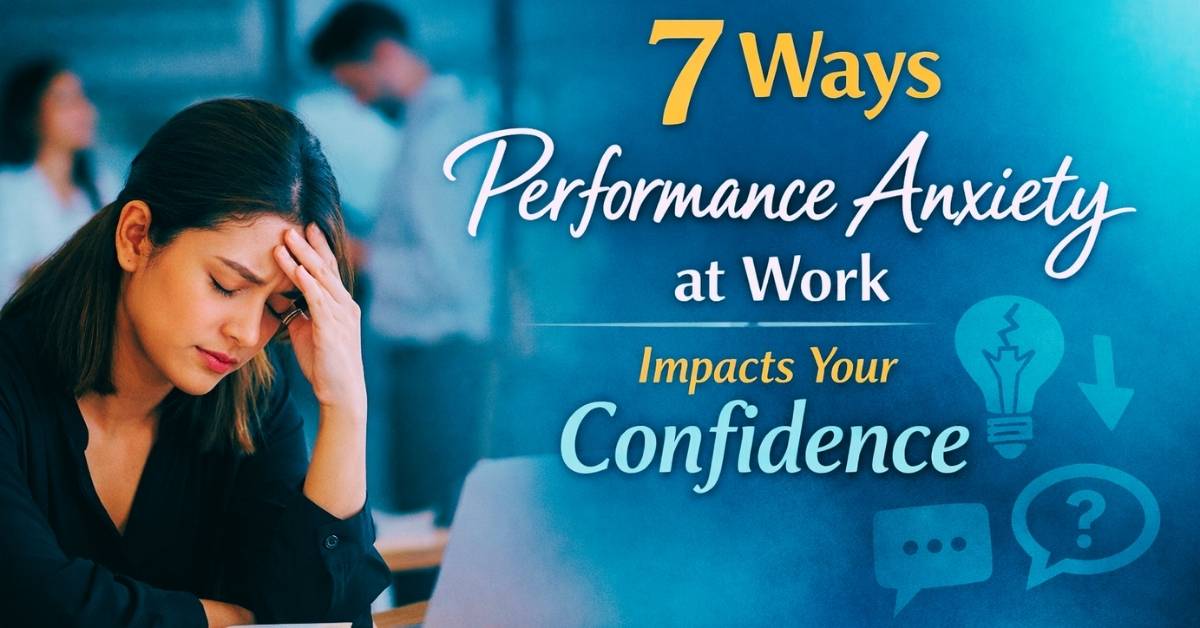
Has it ever happened to you that you were about to present an idea in a meeting or send an important report, and suddenly your heart started racing, your palms started sweating, or your mind went completely blank? That knot in your stomach isn’t just “nerves”; it’s performance anxiety at work, and if ignored, it can slowly destroy your self-confidence. You’re not alone; many professionals feel the same way, although admitting it may feel like admitting weakness.
Performance anxiety at work isn’t limited to high-pressure moments. It’s a cycle of self-doubt, overthinking, and fear of criticism that slowly erodes your view of yourself professionally. You might feel hesitant to speak up in meetings, over-prepare for tasks that don’t require it, or avoid projects that would hone your skills. Even experienced employees can sometimes feel their confidence eroding without even realizing it.
In this post, we’ll explore seven ways performance anxiety at work affects your self-confidence. But more importantly, we’ll share practical exercises, reflection prompts, and tips to help you regain your confidence, reclaim your professional image, and navigate your workday with confidence, even when you’re anxious.
Seven Ways Performance Anxiety at Work Impacts Your Self-Confidence
1. Self-doubt becomes a constant companion
One of the most common ways performance anxiety at work affects your confidence is through constant self-doubt. You may start to doubt your decisions, replay conversations in your mind, or dwell on minor mistakes long after the event has passed. Over time, this can cause you to hesitate taking the initiative or hold back from speaking up in meetings, even when you have something important to say.

The more you question yourself, the more your anxiety will increase. This creates a cycle where every hesitation feels like proof that you’re not capable enough. Many professionals struggling with performance anxiety at work describe feeling like they are “not good enough,” even if their track record suggests otherwise. Gradually, this constant self-questioning can affect your performance and confidence, and unintentionally reinforce the very anxiety you’re trying to control.
Actionable tips:
- Daily reflection: Every morning, write down three good things you did the previous day. These don’t have to be big things; even small progress counts.
- Positive self-talk: Whenever a self-critical thought comes to mind, gently replace it with a more balanced thought, such as: “I’ve dealt with situations like this before, and I can handle this one too.”
- Micro-actions: In meetings, try to share a small thought, question, or insight. These small moments together help you regain confidence in your voice.
2. Fear of failure limits growth
Performance anxiety at work often shows up as a deep fear of getting things wrong. That fear can quietly prevent you from volunteering for new projects, sharing ideas, or striving for promotions you truly deserve. Even when opportunities are right in front of you, anxiety can cause you to stall, overthink every possible outcome, or avoid tasks that would stretch your skills.
When fear begins to guide your decisions, professional growth naturally slows and self-confidence suffers. You may start to feel like there’s a gap between what you know about your abilities and what you feel safe enough to try. Over time, avoiding challenges doesn’t bring relief; rather, it often leads to regret and harsh self-criticism, which only worsens the anxiety.
Actionable tips:
- Reframe mistakes: Write down what you learned from a past mistake. Seeing it on paper will remind you that mistakes aren’t failures, but part of learning and growth.
- Chunk tasks: Break large or challenging projects into small, manageable steps. Focusing on one step at a time makes challenges seem much less overwhelming.
- Visualization exercise: Before starting a difficult task, pause for a moment and imagine yourself successfully completing it. This simple practice can calm your mind and gradually build confidence.
3. Overthinking and perfectionism take over
Another common effect of performance anxiety at work is falling into the trap of overthinking and perfectionism. When you’re worried about how others will evaluate your work, it’s easy to spend too much time editing reports, rereading emails, or double-checking small details that don’t really need to be. While focusing on quality is a good thing, anxiety-driven perfectionism can be exhausting and rarely leads to better results.
Constant overthinking gradually reduces your mental energy and confidence. You may start to feel like whatever you do is never good enough, no matter how hard you try. This hesitation can sometimes appear to coworkers as indecision or self-doubt, which can indirectly impact how confident and competent you appear at work.
Actionable tips:
- Set boundaries: Decide in advance how much time you’ll spend on a task and commit to stopping it when the time is up. This breaks the cycle of constantly revising the task.
- Prioritize: Be honest about which tasks truly require perfection and which will do just fine. Not every task requires the same amount of effort.
- Reflection prompt: At the end of the day, stop and ask yourself: “What went well today? Did I focus my energy on the things that really mattered?”
4. Social anxiety and avoidance can affect team dynamics
Performance anxiety at work doesn’t just show up in how you handle tasks; it often affects how you interact with people. Anxiety can make speaking up in meetings seem scary, sharing ideas feel risky, or networking feel overly stressful. Over time, this avoidance can lead to a feeling of isolation, even if you’re surrounded by coworkers.
When you hold back, it becomes harder to showcase your skills, build meaningful relationships, or feel confident in your professional presence. Feelings of being ignored, excluded, or misunderstood can increase anxiety, creating a cycle where self-consciousness and avoidance reinforce each other. Ultimately, confidence in a team environment fades not because your abilities change, but because anxiety makes it harder to express them.
Actionable tips:
- Start small: Aim to contribute a small suggestion or question at each meeting. These low-pressure moments help rebuild confidence over time.
- Peer check-ins: Schedule brief, informal one-on-one conversations with coworkers. Familiarity can reduce anxiety and make group conversations seem less stressful.
- Role play: Practice a short conversation or presentation with a trusted friend or mentor. Practicing in a safe environment can significantly reduce social anxiety.
5. Physical symptoms reinforce mental strain
Performance anxiety at work isn’t just confined to your thoughts; it often shows up in your body as well. You might notice things like a racing heart before a meeting, stiff shoulders at work, frequent headaches, or a constant feeling of fatigue. These physical reactions can make you feel like you’re losing control, adding another layer of self-doubt and stress.
When anxiety is persistent, it can start to affect your sleep, concentration, and overall energy. And when your body feels tired or stressed, it becomes even more difficult to feel confident or competent at work. It’s not a personal failure; it’s your nervous system’s response to prolonged stress.
Actionable tips:
- Grounding exercise: When anxiety spikes, gently shift your focus to the present moment. Focus on five things you can see, four things you can touch, three things you can hear, two things you can smell, and one thing you can taste. This can help calm your body and mind.
- Breathing practice: Try the 4-7-8 breathing technique: Breathe in for 4 seconds, hold for 7, and exhale for 8. Repeating this a few times can slow your heart rate and reduce stress.
- Movement: Taking a short walk, doing some light exercise, or even just standing up between tasks can reduce stress and help you focus.
6. Negative self-comparison undermines confidence
Performance anxiety at work often leads you to compare yourself to others. You might notice how confidently a coworker speaks in meetings, how quickly another person completes tasks, or how easily others gain recognition, and before you know it, you start comparing your worth to theirs. This constant comparison makes your achievements seem smaller than they really are, which increases anxiety and gradually erodes your self-confidence.
Over time, this pattern can create a silent sense of inadequacy, where even genuine successes don’t feel satisfying. The truth is that comparisons often don’t reveal the full picture. Every professional has their own strengths, challenges, and pressures that are invisible on the surface, including those you are comparing yourself to.
Actionable tips:
- Daily gratitude journal: Write down three things you accomplished today, no matter how small. This will help you focus your attention back on your progress.
- Mindful reflection: When you find yourself comparing yourself to others, stop and ask: “What can I learn from this person instead of feeling inferior?”
- Set personal benchmarks: Set your goals based on your own progress rather than other people’s deadlines. Celebrate your milestones; they matter.
7. Anxiety can affect decision-making
Performance anxiety at work not only affects the way you feel, but it also often shows up in the decisions you make every day. When anxiety takes over, you may start doubting yourself, overanalyzing every option, or putting off decisions for fear of making the wrong choice. Over time, this hesitation can slowly erode your confidence and even slow down your team’s work.
When indecisiveness becomes a habit, it can reinforce the belief that you are not capable or trustworthy enough to handle responsibility. Ironically, the more you delay or avoid decisions, the more you may worry that you will be judged for not taking action. This creates a frustrating cycle where anxiety fuels self-doubt, and self-doubt fuels anxiety.
Actionable tips:
- Time-limited decisions: Set a clear deadline for making a decision, and then stick to it, even if it feels uncomfortable at first. Taking action builds confidence.
- Pros & cons lists: Writing down your options can clear up mental confusion and help you look at decisions more objectively.
- Post-decision reflection: Once you’ve made a choice, reflect on what went well and what you learned, rather than what could have gone wrong.
Breaking the Cycle of Performance Anxiety at Work
Understanding how performance anxiety at work affects your self-confidence is a powerful first step toward change. Awareness helps you stop, reflect, and respond more thoughtfully, rather than staying stuck in old patterns. Below is a simple summary of some practical strategies you can use when anxiety begins to overwhelm you:
- Set realistic expectations: Aim for progress rather than perfection. Doing your best doesn’t mean everything needs to be flawless.
- Seek support: Reach out to a mentor, coach, or trusted colleague. Opening up can provide clarity, reassurance, and perspective.
- Practice self-compassion: Treat yourself with the same patience and kindness you would offer to someone else who’s struggling.
- Focus on skills, not judgments: Instead of worrying about what others might think of you, focus your attention on developing and learning skills.
- Celebrate victories: Take a moment to acknowledge even the smallest victories. These moments mean more than you think.
By understanding these patterns and taking small, deliberate steps, you can begin to break the cycle of anxiety and rebuild self-confidence. Confidence doesn’t mean never feeling afraid; it means taking one thoughtful step at a time, even in the presence of fear.
Final Thoughts
Performance anxiety at work can quietly affect your confidence, your decisions, and the way you approach your job every day. From self-doubt and overthinking to fear of failure and physical stress, its impact is often deeper than it appears.
The good news is that trust can be rebuilt slowly, with small steps. Anxiety can be better managed with simple daily tasks, self-compassion, and the right support. Remember, confidence doesn’t mean the absence of fear, but rather moving forward despite fear.
Start small, track your progress, and trust that consistency will build your confidence. You deserve to feel capable, supported, and confident at work.