
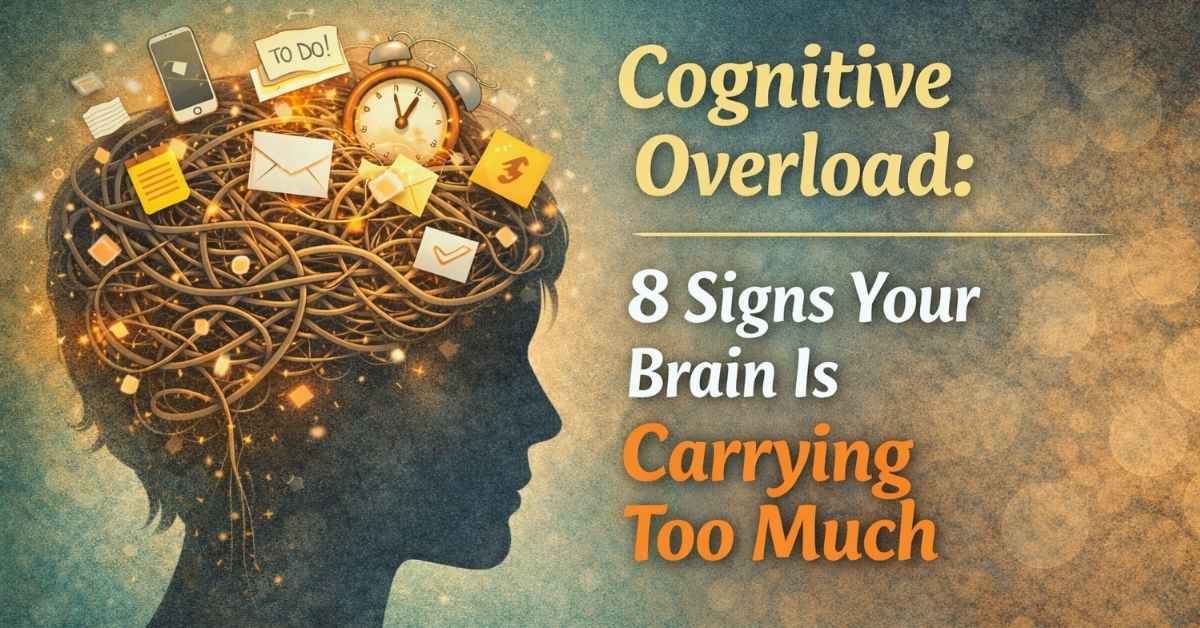
Have you ever felt strangely tired at the end of your workday, even though you didn’t have to do any physical exertion at all? Your body may be fine, but your mind feels chaotic, overstimulated, and unable to fully calm down. That quiet mental heaviness isn’t just about being busy or having a packed schedule. Very often, this is a sign of cognitive overload.
In today’s constantly active work culture, our minds rarely get a chance to rest. We move from email to meeting, notification to decision, deadline to to-do list, often without any real pause in between. There’s always something asking for our attention, and very little space to breathe. Over time, this constant mental pressure slowly builds up, even when we don’t realize it.
The tricky thing is that cognitive overload doesn’t usually show up in dramatic ways. Instead, it appears as small, easily overlooked signs such as mental fogginess, forgetfulness, irritability, or a growing feeling that your brain is no longer working as well as it used to.
In this article, we’ll gently explore what cognitive overload really means, why it’s so common in modern work life, and 8 clear signs that your brain is overloaded, even if you’re still showing up to work and getting things done.
What Is Cognitive Overload?
Cognitive overload occurs when your brain tries to handle more information, decisions, and mental demands at the same time than its actual capacity. Your working memory has limits, and when those limits are repeatedly challenged, your ability to think clearly, concentrate, and function begins to suffer.
Think of your mind like a browser with too many tabs open. At first, things feel a little slower. Then the pages stop responding. And eventually, everything just freezes or crashes altogether.

Unlike physical exhaustion, mental overload is not always easy to recognize. You might still be meeting deadlines, attending meetings, and responding to messages on time, while deep inside you might be feeling overwhelmed, mentally scattered, or strangely numb.
Common causes of cognitive overload include:
- Constant multitasking
- High-pressure decision-making
- Lack of mental breaks
- Emotional labor at work
- Digital overload and nonstop notifications
When mental overload isn’t addressed, it doesn’t go away on its own. Over time, this can lead to chronic stress, exhaustion, anxiety, and a significant decline in mental performance.
8 signs of cognitive overload in your brain
1. You struggle to focus on simple tasks
One of the early signs of cognitive overload is difficulty concentrating even on tasks that previously seemed easy.
You may notice:
- Reading the same sentence multiple times
- Losing track of what you were doing
- Taking longer to complete routine work
- Feeling mentally “slippery”
This is not laziness or indiscipline. When your brain is overloaded with information, it struggles to filter and maintain focus. Too many mental demands are competing for a limited amount of cognitive energy.
Your ability to concentrate hasn’t gone away; it’s just tired and asking for a rest.
2. You feel mentally tired even after resting
If you wake up feeling mentally tired, mental overload could be a reason. Sleep helps your body recover, but your mind needs much more than just hours spent in bed to refresh fully. When your thoughts are busy replaying work-related conversations, worrying about responsibilities, or thinking about unfinished tasks, your mind never completely shuts off.
You might notice:
- Mental fog in the morning
- Difficulty making decisions early in the day
- Feeling “behind” before work even begins
This kind of persistent fatigue isn’t normal fatigue. It’s a sign that your brain has been carrying too much weight for too long.
3. Small decisions feel overwhelming
Decision fatigue is one of the clearest signs of mental overload.
You may find yourself:
- Overthinking choices that should be simple
- Putting off decisions altogether
- Feeling anxious about making the “wrong” call
- Procrastinating more than usual
When your mind is overloaded, every decision seems burdensome. Even small things like what to eat, which task to start, or which email to respond to first can suddenly seem exhausting.
Your brain isn’t breaking down. It’s just doing its best to conserve energy when resources are running low.
4. You’re more irritable or emotionally reactive
Information overload doesn’t just affect the way you think; it also shows up in the way you feel.
You may notice:
- Getting irritated over small things
- Feeling more emotionally sensitive than usual
- Snapping at colleagues or loved ones without meaning to
- Having less patience and tolerance overall
When your mental energy is drained, it becomes difficult to control emotions. Your brain has less capacity to pause, process, and respond calmly, so reactions tend to come out sharper than intended.
This emotional reaction is often mistaken for a personality flaw or a “bad mood.” In reality, it’s often a sign that your brain is struggling with excessive cognitive stress.
5. You forget things more often than usual
Forgetfulness is a common, but often overlooked, sign of mental overload.
This might look like:
- Missing meetings or appointments
- Forgetting parts of conversations you just had
- Losing track of tasks you meant to come back to
- Struggling to recall information you read only moments ago
When your brain is overloaded, it goes into survival mode instead of memory mode. As a result, important details are not always stored as they normally should be.
This does not mean that your memory is failing. It means that your cognitive system is under immense pressure and trying to perform at its best.
6. Multitasking feels impossible (yet you keep doing it)
Ironically, when you’re struggling with information overload, you may feel even more pressure to multitask, even as you notice that it’s becoming increasingly difficult to keep pace.
You may notice:
- Slower switching between tasks
- Making more mistakes than usual
- Feeling mentally scattered or unfocused
- Deep mental exhaustion after trying to juggle
Multitasking increases the cognitive load on your brain because it forces your brain to constantly switch its attention. Over time, this drains mental energy, increases fatigue, and makes tasks seem more difficult than they need to be.
Your brain is not designed to multitask. It works best when it can focus on one thing deeply and without interruption.
7. You feel constantly “behind,” no matter how much you do
Constantly feeling behind, even when you have completed work, is a strong emotional indicator of mental overload.
Even after completing tasks, you may still feel:
- Unsatisfied or oddly restless
- Anxious about what needs to happen next
- Unable to mentally “check off” your work, like the to-do list never truly ends
This happens when your mind is trying to handle too many open loops at the same time. Without a sense of mental closure, everything starts to feel urgent, even when it doesn’t actually need to be.
The result is a constant, low-level anxiety that lingers in the background and never fully goes away.
8. Your creativity and problem-solving feel blocked
Creativity requires mental relaxation. When cognitive overload sets in, that relaxation gradually disappears.
You may experience:
- Struggling to come up with ideas
- Thinking in rigid or repetitive ways
- Difficulty seeing solutions you once spotted easily
- A noticeable drop in curiosity or creative energy
This doesn’t mean you’ve lost your creativity or problem-solving skills. This is a sign that your cognitive abilities are overstretched. An overly busy brain focuses on immediate demands, not exploration or new ideas.
When mental stress subsides, creativity often returns naturally and without pressure.
How Cognitive Overload Impacts Long-Term Mental Health
When cognitive overload is left unchecked, it not only impacts your daily routine but can also shape your mental health over time.
Prolonged mental strain may lead to:
- Chronic stress
- Anxiety disorders
- Burnout
- Emotional exhaustion
- A noticeable drop in job satisfaction
If this happens constantly, your brain can become accustomed to being in a constant state of alert. It becomes harder to truly relax, switch off, or feel mentally safe, even during moments of rest.
Recognizing mental overload early is an act of self-care, not a sign of weakness. It’s about listening to your mind before it’s forced to ask louder.
Gentle Ways to Reduce Cognitive Overload
You don’t need to change everything in your life to reduce information overload. Small, deliberate changes can quietly bring great relief.
1. Reduce mental clutter
Instead of trying to keep everything in your head, write things down. When tasks are written down on paper or in a list, your mind has a little more room to relax.
2. Create focused work blocks
Doing one thing at a time may feel slower, but it actually reduces cognitive strain and helps you work with more clarity.
3. Take true mental breaks
Whenever possible, avoid using screens during breaks. Even a few minutes without any external input gives your brain a chance to rest and re-energize.
4. Set clear boundaries
Being available all the time keeps your mind on high alert. Setting gentle but firm boundaries helps protect your mental energy.
5. Practice mental closure
At the end of the day, make a note of what tasks you have completed and what can be postponed until tomorrow. This small habit helps your mind relax and take a break from work completely.
Cognitive Overload vs. Burnout: What’s the Difference?
Although cognitive overload and burnout are closely linked, they are not the same thing.
Mental overload is often an early warning sign. It manifests as mental fatigue, trouble concentrating, and emotional strain, even while you’re still performing, getting work done, and pushing through the day.
Burnout usually develops when mental overload is ignored for too long. That’s when exhaustion becomes constant, motivation starts to fade, and you may feel emotionally detached or disconnected from work and life.
The good news is that cognitive overload is easier to deal with when you notice it early. Paying attention to these signs and making small changes can help prevent burnout before it takes over.
Final Thoughts
Living with cognitive overload doesn’t mean you’re incapable. More often, it means you’ve been capable for a long time, without enough space, support, or recovery in between.
Your brain was never meant to handle endless information, constant decisions, and emotional pressure all at once. When it starts to feel overloaded, it isn’t failing. It’s trying to protect you by asking for relief.
Easing mental overload starts with awareness, not perfection. Small changes, gentle boundaries, and moments of mental calm can gradually bring clarity back. You don’t have to fix everything all at once to feel better.
You don’t have to work harder or put in more effort to recover.
Sometimes, your mind simply needs less to carry.